



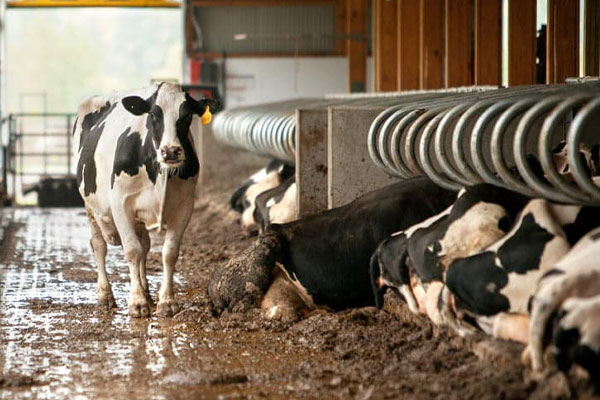
Heat stress affecting a dry cow today can reduce milk production in her next lactation and potentially affect the health and performance of her offspring. This was one of the key findings presented at this year’s Dairy Management Consulting (DMC) Hollard Conference, where specialists examined how management decisions made during the dry and transition periods can influence long-term herd performance.
Presentations covering transition-cow monitoring, heat stress, reproduction, milking performance and genomics highlighted the importance of combining reliable data with sound herd-management practices and timely intervention.
Dry-cow behaviour provides an early warning
Dr Marco de Groot, performance specialist at CowManager, explained how behavioural monitoring can help identify dry cows at risk of health problems after calving.
Changes in feed intake, rumination and inactivity can provide early indicators of problems associated with feed and water availability, heat stress, overcrowding, lameness or repeated movement between groups.
On commercial farms, relatively simple management changes, including additional water access, more frequent fresh-feed delivery and reducing unnecessary animal movement, have produced measurable improvements.
The key message is that post-calving health and productivity are often influenced by conditions experienced during the dry period.
Heat stress can affect future generations
Dr Jimena Laporta, associate professor of lactation physiology at the University of Wisconsin-Madison, highlighted the longer-term effects of heat stress during the dry period.
Research presented at the conference indicated that cows exposed to heat stress while dry produced approximately 5 kg less milk per day during their subsequent lactation than cows kept under cooler conditions. Effects were also observed in their daughters, including reduced survival and productive performance.
The potential impact can extend further because a developing heifer already carries the oocytes that may eventually produce the next generation.
Heat stress is also a concern in pre-weaning calves. Elevated body temperatures and increased respiration can affect milk and starter-feed intake, growth, immune development and disease resistance. Conditions such as pneumonia and scours can become more likely when calves experience prolonged heat stress.
Laporta recommended shade as the first line of protection, complemented where necessary by fans, improved ventilation and, under suitable climatic conditions, airflow combined with misting.
Fertility begins before insemination
Dr Luca Fabozzi, dairy technical specialist at Zinpro, emphasised that reproductive performance is multifactorial and requires accurate diagnosis.
Farmers need to establish whether cows are failing to cycle, failing to show oestrus, failing to conceive or experiencing embryo loss, as each problem requires a different management response.
Fabozzi said excessive loss of body condition can pose a greater reproductive risk than high milk production itself. He recommended a calving body condition score of approximately 2.75–3.25, with cows entering the dry period in suitable condition.
Nutrition, heat stress, inflammation and transition-cow health can influence follicular development weeks or months before insemination. Ketosis, lameness and mastitis can also negatively affect conception and embryo survival.
Maintaining dry-matter intake, adequate feed and water access, cooling, cow comfort and appropriate stocking density are therefore important components of reproductive management.
Milking performance requires precision
Milkrite | InterPuls specialist Gijs Hampsink addressed the challenge of achieving rapid, complete and gentle milking without compromising teat and udder health.
He advised farmers to assess vacuum conditions during actual milking rather than relying solely on system-level vacuum readings. Measuring vacuum beneath the teat during peak milk flow can provide a more accurate indication of what the cow experiences.
Allowing approximately 60–90 seconds between stimulation and cluster attachment can promote continuous milk flow and reduce low-flow milking.
Teat condition should also be checked immediately after cluster removal. Swelling, redness or discolouration can indicate excessive vacuum, unsuitable liners or incorrect pulsation settings.
Genomics strengthens breeding decisions
Swartland dairy farmer Van der Byl du Toit highlighted the role of genomics in evaluating genetic potential and improving breeding decisions.
However, he cautioned that genomics cannot compensate for poor management, inadequate facilities or inappropriate breeding objectives. Farmers should select breeding indexes according to their production systems, milk-payment structures and financial objectives.
His approach focuses on developing balanced, long-lived cows rather than selecting solely for maximum milk yield.
Data-driven dairy management
The conference demonstrated how dairy productivity increasingly depends on decisions made before problems become visible. Behavioural monitoring, heat-stress management, reproductive analysis, precision milking and genomic selection are giving producers more tools to identify risks and improve herd performance.
For dairy farmers, the message is clear: monitor earlier, measure accurately and manage proactively. Decisions made during the dry period, calf stage and breeding programme can influence not only current production, but the performance and sustainability of future generations of the herd.
