


Why Seed Placement Accuracy Determines Profitability Before the Season Begins
Rovic, a South African agricultural mechanisation company, specialises in the engineering, manufacturing and distribution of farming equipment designed to improve productivity and operational efficiency. Its solutions span tillage, spraying and precision planting, helping farmers manage production risks while maximising the potential of every hectare.
Across South Africa’s winter rainfall regions, winter grains remain an important component of crop rotations. However, long before rainfall patterns, fertiliser programmes or disease pressure influence final yields, one critical factor is already shaping crop performance: precision seed placement.
While farmers closely monitor seed costs per hectare, the hidden cost of inconsistent crop establishment can be far greater. Uneven emergence, inconsistent planting depth, poorly positioned fertiliser and excessive competition between neighbouring plants can compromise yield potential before the crop even emerges.
For Rovic, precision planting is more than a mechanical operation. It is an investment in crop establishment, yield potential and farm profitability.
The Financial Reality of Uneven Emergence
Every seed represents genetic potential, but that potential can only be realised when planting conditions support uniform establishment. Key factors include:
- Consistent seed placement depth.
- Controlled soil disturbance.
- Accurate fertiliser positioning.
- Reduced competition between neighbouring plants.
When seeds emerge at different times, earlier and more vigorous plants can gain a competitive advantage over later-emerging neighbours. This can result in uneven crop development, inconsistent tillering and variable maturity at harvest.
Unlike certain nutrient deficiencies or pest pressures that can be managed during the growing season, planting errors are often difficult or impossible to correct once the crop has been established. Poor depth control, irregular spacing and inappropriate fertiliser placement can therefore have lasting consequences for yield potential.
Engineering for Consistency: The SyncroSeed Approach
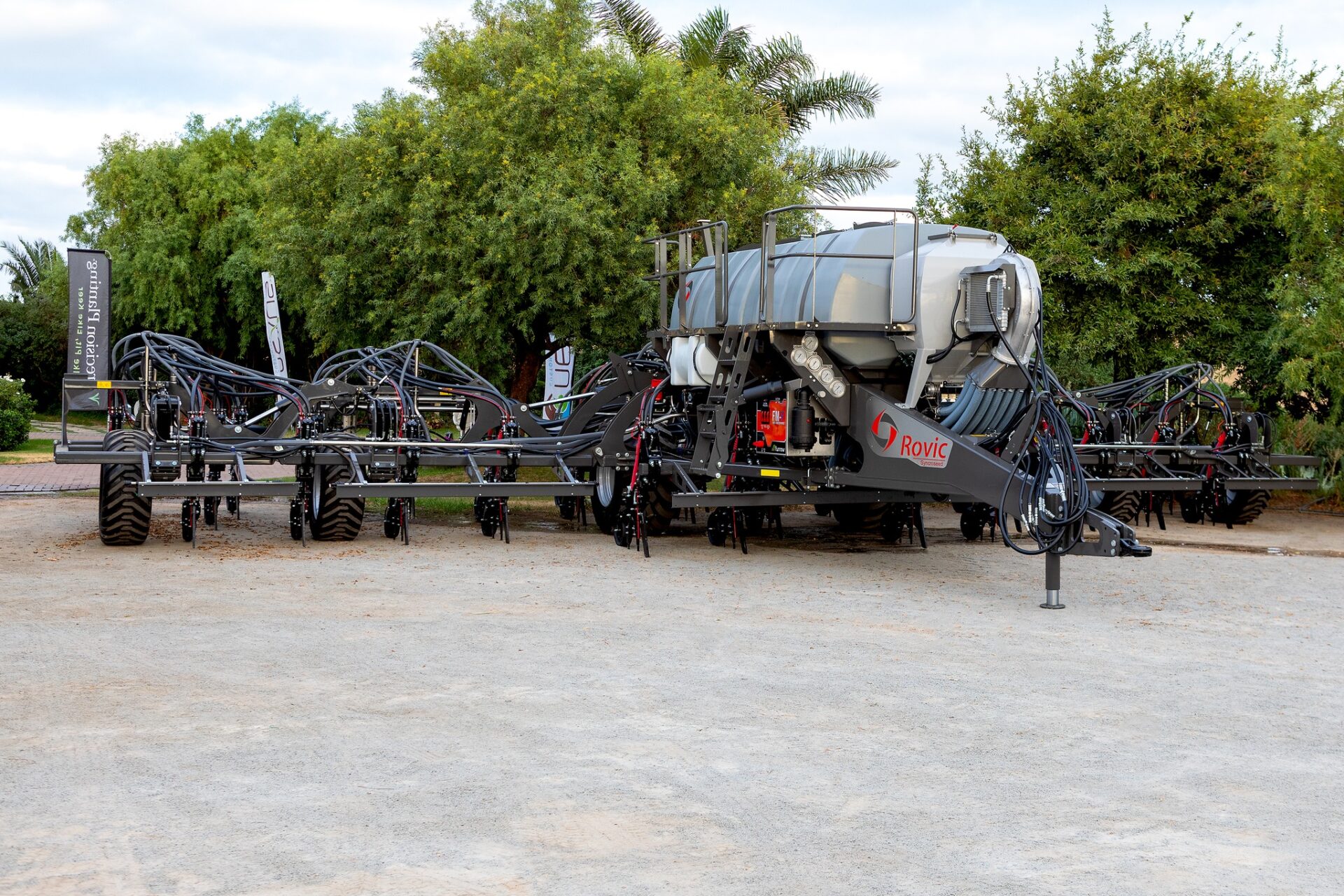
The Rovic SyncroSeed Wheat Planter is designed to deliver consistent planting depth, accurate seed metering and reliable fertiliser placement across varying soil conditions and terrain.
At the heart of the machine is a new-generation tine unit featuring a stated breakaway force of 700 kg at 90 bar hydraulic pressure. This design helps the tine maintain its working position as soil resistance changes while providing protection for the machine frame under demanding field conditions.
The tine incorporates a replaceable 16 mm-wide tungsten tile point, engineered for durability and extended service life in abrasive soils. Operators can adjust seeding depth and closing-wheel pressure to suit changing soil moisture conditions and residue levels.
With 560 mm of ground clearance at a working depth of 150 mm, the SyncroSeed is designed to operate in high-residue conditions and cover-crop systems, supporting consistent performance across a range of planting environments.
Patented Dual Seed Placement: A Different Approach
One of the SyncroSeed’s distinguishing features is its patented Dual Seed Placement system.
Rather than relying on conventional single-placement configurations, the system is designed to position seed and fertiliser in specific locations within the furrow to support crop establishment and early development.
The intended benefits include:
- Improved early root development.
- Reduced risk of fertiliser damage to germinating seeds.
- Stronger early crop vigour.
- More uniform crop emergence.
By managing the relative positioning of seed and fertiliser, the system aims to create more favourable conditions for early growth, helping crops establish consistently and compete more effectively.
Accurate Metering Across Field Conditions
Consistent seed and fertiliser delivery is essential for achieving the intended planting rate and placement accuracy. The SyncroSeed uses an air-delivery system powered by a Crary fan and a bent-axis piston motor to provide the airflow required for reliable distribution.
A high-capacity oil cooler is fitted as standard to help manage hydraulic temperatures during extended planting operations.
The planter can apply granular fertiliser at rates of up to 400 kg/ha, using a modern metering unit designed to maintain application accuracy across varying terrain, including hilly fields.
Interchangeable seed rollers are available for wheat, large pellets and fine seed, providing flexibility for different seed types and planting requirements.
Flexible Tank Configurations for Modern Farming
The SyncroSeed range offers tank configurations with total capacities ranging from 6,500 litres to 8,300 litres, depending on the drawbar configuration.
The tanks can accommodate dry or liquid products, allowing farmers to integrate different nutrient-management strategies into their planting operations. An optional In Furrow Management System supports the application of liquid products directly into the furrow.
Positioning inputs where they are needed can support more targeted application and improve nutrient-use efficiency, depending on the product, application rate and prevailing soil conditions.
These options give farmers greater flexibility when planning input delivery and managing operational requirements during the planting season.
Built for Large-Scale Planting Efficiency
Available in configurations ranging from 21 to 43 tines, the SyncroSeed offers working widths of up to 12.9 metres at 300 mm tine spacing, making it suitable for large-scale planting operations.
Its three-rank frame design is intended to promote residue flow and maintain consistent tine spacing. Load balancing across the wings helps support uniform working depth over the full width of the machine, including when operating across uneven terrain.
Additional features are designed to simplify daily operations and improve usability. Colour-coded hydraulic couplings make tractor connections easier, while standard working lights support visibility during extended planting windows.
The planter also features a self-cleaning, moulded rubber V-shaped press wheel designed to minimise soil being thrown into neighbouring rows and help preserve row definition during establishment.
Together, these design elements aim to combine planting accuracy with the operational capacity required to cover large areas within increasingly demanding planting windows.
The Bottom Line: Precision Is an Investment in Yield Potential
In crop production, profitability begins long before the first rainfall event. It starts with the decisions made during planting.
Consistent seed depth, accurate fertiliser placement, controlled soil disturbance and uniform crop emergence are fundamental to establishing a productive crop. They are not simply technical considerations; they form part of a broader strategy to manage risk and protect yield potential.
By combining patented seed-placement technology, precision metering and durable engineering, the Rovic SyncroSeed Wheat Planter is designed to make planting a more controlled and consistent operation.
For South African wheat producers, the message is clear: planting precision is an investment in yield potential, operational efficiency and profitability. The foundation for a successful harvest is laid one accurately placed seed at a time.
