


Regrow has introduced Ag-gentic, an artificial intelligence (AI) agent platform designed to automate agricultural data integration and improve field-level environmental intelligence. The technology could be relevant to African agribusinesses, food producers and agricultural lenders seeking better ways to assess crop performance, climate risks and supply chain sustainability.
Across Africa, agricultural decision-making is increasingly shaped by variable rainfall, drought, soil degradation and the need to improve food production. Reliable information about weather patterns, soil conditions, farming practices and crop performance can help organisations respond to these challenges. However, agricultural data is often fragmented across different systems, making it difficult and costly to combine information for large-scale analysis.
Regrow developed Ag-gentic to address these data integration challenges by automating the construction, execution and maintenance of agricultural data pipelines. The platform works across the company’s Agriculture Resilience Platform and commercial application programming interfaces (APIs), with the aim of providing scalable environmental intelligence to food manufacturers, agribusinesses and agricultural lenders.
AI Automates Complex Agricultural Data Processing
Traditional agricultural data workflows often require specialist developers to resolve missing datasets, inconsistent formats and differences in geographical coverage. These challenges can slow environmental modelling and increase the cost of analysing agricultural production systems.
Ag-gentic uses an autonomous AI agent architecture to coordinate data processing tasks and reduce the need for manual pipeline development.
Its design incorporates four key principles: modular processing, automated data validation, safe re-execution and computing cost estimation.
Each processing step performs a defined function, with documented inputs and outputs. Automated checks identify incomplete information and data inconsistencies before datasets are passed to environmental models.
The platform also supports repeatable processing, allowing interrupted tasks to be restarted without unnecessarily duplicating data or compromising existing records. Computing requirements are estimated before execution, helping organisations anticipate infrastructure costs when processing large volumes of geospatial information.
During a six-month deployment phase, the platform’s codebase incorporated more than 105 AI agent-authored pull requests, subject to internal scientific auditing, according to the reported technical details.
Combining Satellite, Weather and Soil Data
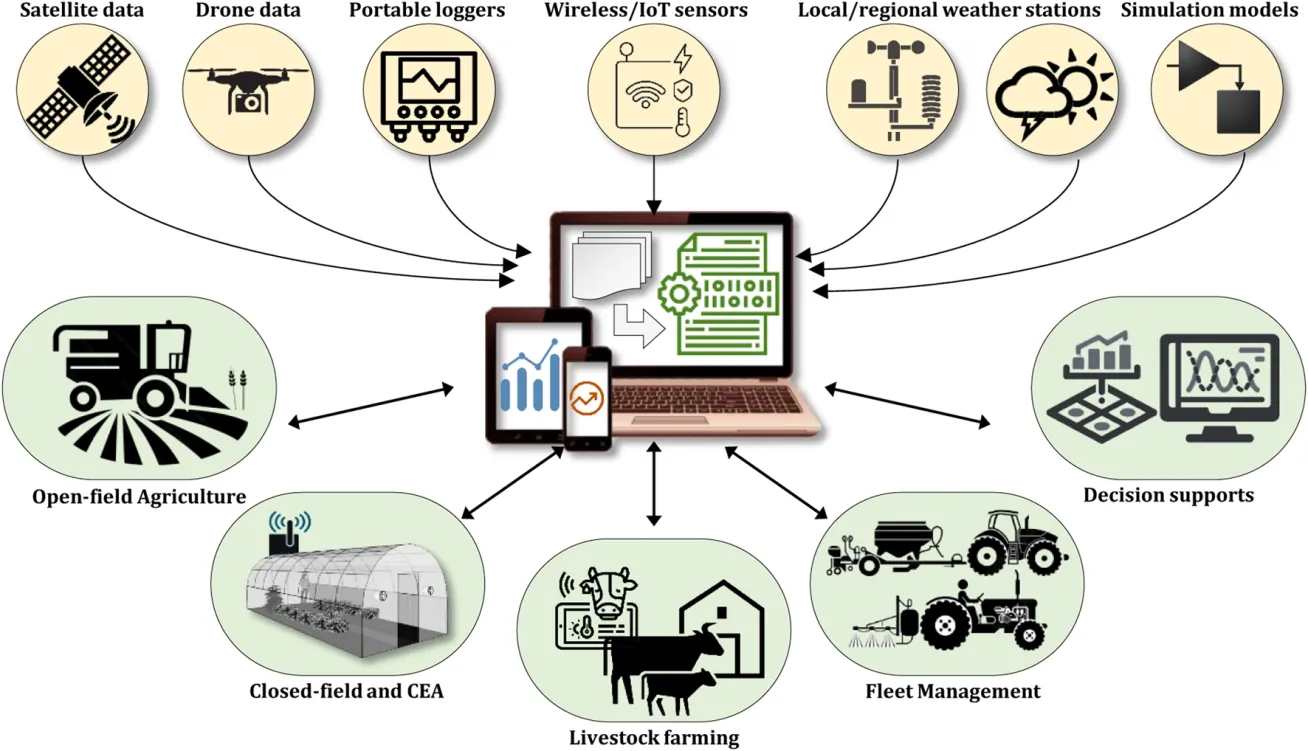
A central capability of Ag-gentic is its ability to combine different agricultural datasets into a standardised record for each field and growing season.
These datasets include satellite imagery, weather grids, soil characteristics, drought monitoring information and farmer-reported operational records. Bringing these sources together can help organisations build a more consistent picture of agricultural conditions and environmental performance.
For African agricultural supply chains, this type of data integration could support applications such as drought-risk assessment, crop monitoring, soil management, agricultural lending and the verification of sustainability initiatives.
For example, combining satellite observations with weather and soil data could help analysts identify areas experiencing moisture stress, compare crop performance across growing seasons and assess how farming practices relate to harvest outcomes. These are potential applications of the underlying technology, rather than confirmed African deployments of Ag-gentic.
Reported Results Show Potential for Large-Scale Analysis
In a technical deployment examining the relationship between regenerative farming practices and crop yield stability during drought, Ag-gentic automated the integration of more than 20 independent geospatial and agronomic data layers.
The reported results indicated that the redesigned processing approach reduced computational expenditure for a nationwide agricultural data layer by approximately 60 times.
The resulting dataset supported an analysis of around 152,000 crop cycles within a single quarter, examining relationships between soil carbon levels, agricultural management practices and harvest outcomes across regional supply sheds.
Although these results do not establish performance under African farming conditions, they demonstrate the potential of automated data integration to support large-scale agricultural analysis while reducing data processing costs.
What Could This Mean for African Agriculture?
Africa’s agricultural sector includes smallholder farmers, commercial farms, agricultural cooperatives, food processors and regional commodity traders operating under widely differing conditions. Access to reliable, localised agricultural information remains important for improving productivity, managing climate risks and strengthening food supply chains.
AI-driven data integration could help agribusinesses and agricultural lenders combine information from multiple sources to improve risk assessment, monitor production conditions and support more informed investment decisions.
However, practical adoption across African markets would depend on factors such as the availability and quality of local data, satellite coverage, connectivity, integration with existing agricultural systems and affordability. Local validation would also be necessary to ensure that models reflect the continent’s diverse climates, crops, soils and farming practices.
Regrow’s Ag-gentic platform illustrates how AI can help address the data engineering challenges behind environmental and agricultural modelling. For Africa, the broader opportunity lies in adapting such technologies to local production systems and using reliable field-level intelligence to support climate resilience, sustainable farming and stronger agricultural supply chains.
