



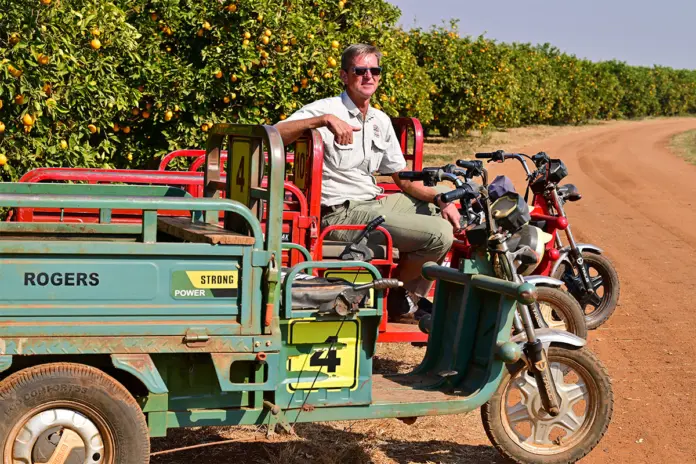
After seven years of daily use on a busy farming operation in Limpopo, Lekkewaan’s compact electric utility vehicles have demonstrated how low running costs, reliability and practical design can support modern agriculture.
Citrus farmer Hennie de Beer first encountered the Lekkewaan brand seven years ago when Pierneef Smit, then general manager at Lekkewaan, supplied a TailG 1.3 for evaluation at Vaalbos Trust.
De Beer quickly recognised that the vehicles could be used effectively for specific tasks across the farm.
The business is committed to sustainable and environmentally responsible farming practices, making the vehicles’ zero-emission operation a natural fit with its long-term objectives. It also actively adopts agricultural technologies that can improve efficiency while reducing environmental impact.
Lower operating costs
One of the main advantages has been the reduction in fuel and maintenance costs.
“What I like about the Lekke TailG 1.3 is that it requires very little maintenance, and has significantly reduced our fuel expenditure because we now use the TailGs as run-arounds instead of bakkies or tractors,” says De Beer.
The vehicles use lead-acid batteries, which typically last around two years, according to De Beer.
The TailGs are primarily used by the irrigation team to travel between citrus orchards, maintain irrigation systems, start and stop pumps, and inspect centre pivots.
Previously, workers relied on bakkies or travelled on foot between orchard blocks. Using compact electric vehicles allows staff to move around the farm more efficiently without the fuel consumption associated with larger vehicles.
The vehicles are also used by the security team to patrol perimeter fences at night. Their quiet operation makes them particularly suitable for this role compared with quad bikes or bakkies.
Built for farm conditions
The TailGs have also demonstrated their durability in demanding agricultural conditions.
Built around a robust metal frame, one vehicle was involved in a collision with a Toyota bakkie. According to De Beer, the bakkie sustained significant damage while the TailG suffered little visible damage, and its driver was not injured.
Vaalbos Trust currently operates three-wheeled TailG models, but De Beer is considering adding four-wheeled vehicles such as the Lekke Noddy or Lekke Mini to the fleet.
The farm may also consider side-by-side models if they become available, with potential use by production managers and supervisors.
An alternative to quad bikes
The electric vehicles have also provided an alternative to the quad bikes previously used on the farm.
De Beer says the Lekkewaan vehicles offer savings on fuel and maintenance while being slower and, in his view, safer than quad bikes. Their quieter operation and lower dust generation are additional benefits, particularly around citrus orchards located alongside farm roads.
Although the vehicles are not specifically designed as dedicated off-road machines, De Beer says they have performed well on the farm’s terrain.
After-sales support has also been important, with replacement parts readily available when required.
The TailGs are not routinely used to transport heavy loads, but they can carry smaller items such as hay bales for horses or limited quantities of citrus for inspection.
Practical limitations
The three-wheel configuration does require drivers to adjust to the vehicle’s handling characteristics. De Beer notes that inexperienced drivers can occasionally turn too sharply, resulting in minor collisions with fences or other vehicles.
The standard tyres supplied with the vehicles are another concern. According to De Beer, the tyres can be prone to punctures, particularly when operating across rough terrain.
Despite these limitations, the overall operating savings remain a major factor in the farm’s continued use of the vehicles.
“For us, the significant savings on fuel and bakkie maintenance costs is probably the biggest reason why we would recommend the Lekke TailG to fellow farmers,” De Beer concludes.
The experience at Vaalbos Trust highlights the growing potential for electric utility vehicles in agriculture, particularly for routine farm mobility, irrigation management and security operations where low operating costs, quiet operation and reduced emissions can provide practical advantages.
