



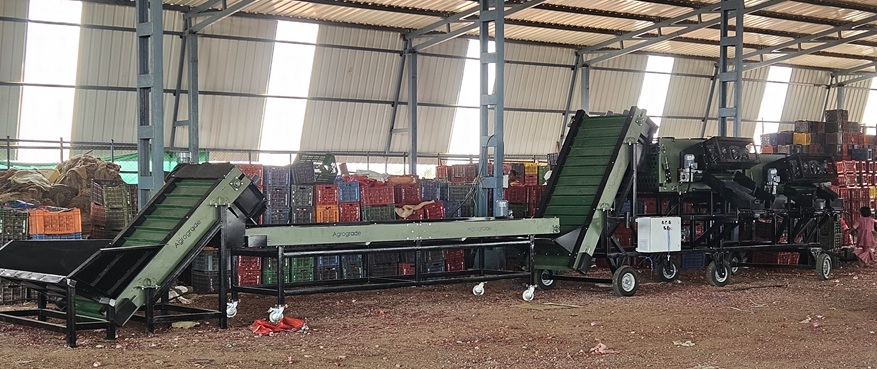
Agrograde’s system can process up to 10 metric tons of onions per hour and reduce grading labor requirements by nearly 80 percent.
A new automated onion grading system being deployed in India could offer lessons for African agriculture, where labor-intensive post-harvest handling remains a challenge for many producers and traders.
Agricultural technology company Agrograde has installed its GradePlus Pro onion grading system at a farmer producer company in Pimpalgaon, a major onion trading and export hub in India’s Nashik district.
According to figures released by the company, the system can process up to 10 metric tons of onions per hour, reduce the labor required for grading by nearly 80 percent compared with manual sorting, and achieve 99 percent grading accuracy.
The technology is designed to address one of the challenges associated with onion handling: maintaining product quality while increasing processing speed.
Agrograde says its system uses Wave Motion Technology, which moves onions through the grading line with less abrupt contact than conventional mechanical equipment. The company says this approach is intended to reduce skin scuffing and peeling, while increasing throughput by three to five times compared with manual grading.
The system also automates unloading and bagging, further reducing manual handling.
Why It Matters for African Onion Value Chains
Across Africa, onion producers and traders face challenges linked to post-harvest handling, labor availability, product quality and access to efficient processing infrastructure.
For onions destined for longer-distance markets, damage to the outer skin can reduce shelf life and affect market value. This makes grading and handling technology particularly important as African producers and agribusinesses seek to improve storage, processing and export performance.
Agrograde says some imported grading machines have struggled with the thin outer skin of Indian onion varieties, causing peeling and damage. The company says its system was developed specifically around the requirements of India’s onion supply chain.
While the technology has not yet been reported as being deployed in Africa, its approach could be relevant to African onion-producing regions looking to increase mechanisation without compromising crop quality.
Taking Grading Closer to Farmers
Agrograde has also developed a tractor-mounted version of its grading system, allowing the equipment to be moved between farms, packhouses, cold storage facilities and wholesale markets.
Such mobile systems could be particularly interesting for agricultural markets where grading infrastructure is concentrated in a small number of locations. Bringing grading closer to farms could potentially reduce unnecessary handling and improve the efficiency of the post-harvest chain.
Rakeshkumar Barai, co-founder of Agrograde, said the company focused on developing equipment suited to the specific conditions of the Indian onion supply chain rather than adapting machinery designed for other markets.
“We have now brought down the grading costs to almost INR 0.05 per kilogram at speeds up to 200 MT per day,” Barai said.
For Africa, the broader lesson is that post-harvest mechanisation does not necessarily have to focus only on increasing speed. Technologies that combine higher throughput, lower labor requirements and reduced crop damage could help strengthen agricultural value chains and improve the quality of produce reaching domestic and export markets.
The next question is whether similar technologies can be adapted economically to African production systems, where farm sizes, infrastructure, labor costs and market structures vary considerably between countries.
