



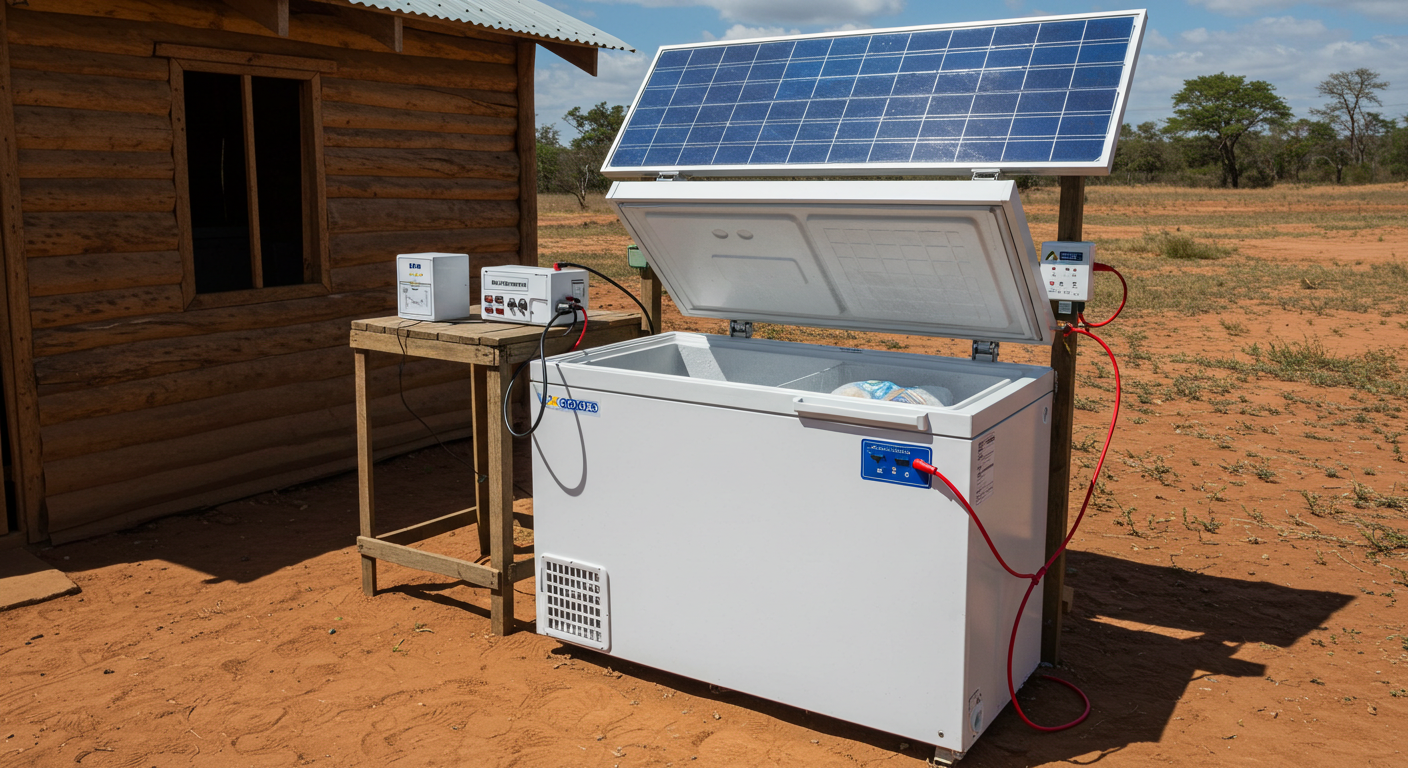
Across Africa, investment in agricultural technology is increasingly shifting toward the physical infrastructure needed to reduce food losses after harvest. Solar-powered freezers, cold rooms, refrigerated transport and biodigesters are emerging as technologies for improving food storage, processing and resource efficiency.
Sub-Saharan Africa loses a significant share of its agricultural production after harvest, with inadequate cold storage, unreliable electricity and long transport distances contributing to spoilage. This challenge has created opportunities for agritech companies developing infrastructure that can preserve food and capture value from agricultural waste.
Solar Cold Storage Expands
Nigeria has become an important market for solar-powered cold-chain technology. Companies such as Koolboks and Eja-Ice are developing off-grid refrigeration systems designed for farmers, food vendors and businesses operating in areas with limited access to reliable electricity.
These systems use solar power to provide refrigeration without depending entirely on conventional electricity networks. Larger installations can also support cold rooms and refrigerated transport, helping maintain suitable temperatures as food moves from farms to markets.
The technology addresses a critical part of the agricultural supply chain. Improving storage and transportation conditions can extend the usable life of perishable products such as fruits, vegetables, fish and other temperature-sensitive foods.
Converting Agricultural Waste into Energy
Other companies are addressing challenges further along the farm cycle by converting agricultural and livestock waste into useful energy and agricultural inputs.
Kenya-based Sistema.bio, for example, develops prefabricated biodigesters that process organic waste into biogas and biofertiliser. The biogas can be used as an energy source, while the remaining material can be applied as an agricultural input.
This approach allows farmers to extract additional value from materials that might otherwise be discarded. It also connects waste management, renewable energy and agricultural production within a single system.
Moving Beyond Farm-Gate Technology
The growing focus on cold-chain and processing infrastructure represents a broader development in African agritech. Earlier technology investments often concentrated on digital platforms connecting farmers with information, markets and financial services.
Physical infrastructure addresses a different constraint. Digital tools can help farmers identify buyers or improve production decisions, but those benefits can be undermined if harvested crops subsequently spoil because of inadequate storage, unreliable electricity or inefficient transportation.
Cold storage, processing facilities and refrigerated logistics therefore form an important part of the infrastructure connecting farms to consumers.
Ethiopia’s Processing Opportunity
Ethiopia provides another example of investment moving beyond primary production. Companies working in the country’s agricultural sector are seeking to expand processing and export capacity for crops such as teff.
Increasing local processing capacity could allow more agricultural value to be captured within producing countries rather than relying primarily on the export of unprocessed commodities.
Why Infrastructure Matters
The growing interest in agricultural hardware reflects the scale and complexity of Africa’s food systems. Reducing post-harvest losses requires more than increasing farm productivity. Farmers also need reliable storage, energy, transportation, processing facilities and access to markets.
Solar refrigeration can provide an alternative where grid electricity is unreliable, while biodigesters can turn agricultural waste into energy and fertiliser. Together, these technologies demonstrate how renewable energy and agricultural infrastructure can be integrated into efforts to improve food-system efficiency.
As investment in African agritech evolves, the focus on infrastructure between harvest and market could become an increasingly important part of the continent’s agricultural technology landscape.
