


Robotic milking technology has transformed dairy farming in parts of Europe and other developed markets, and the technology is now attracting growing interest from larger commercial dairy operations in Africa.
The shift has been gradual. High equipment costs, herd sizes, infrastructure requirements and the economics of labour have historically made automated milking difficult to justify for many African dairy farms.
However, advances in robotics, artificial intelligence, sensors and farm-management software are changing the proposition. South African dairy farmers are increasingly evaluating whether automated milking can improve efficiency, animal monitoring and farm management.
How robotic milking works
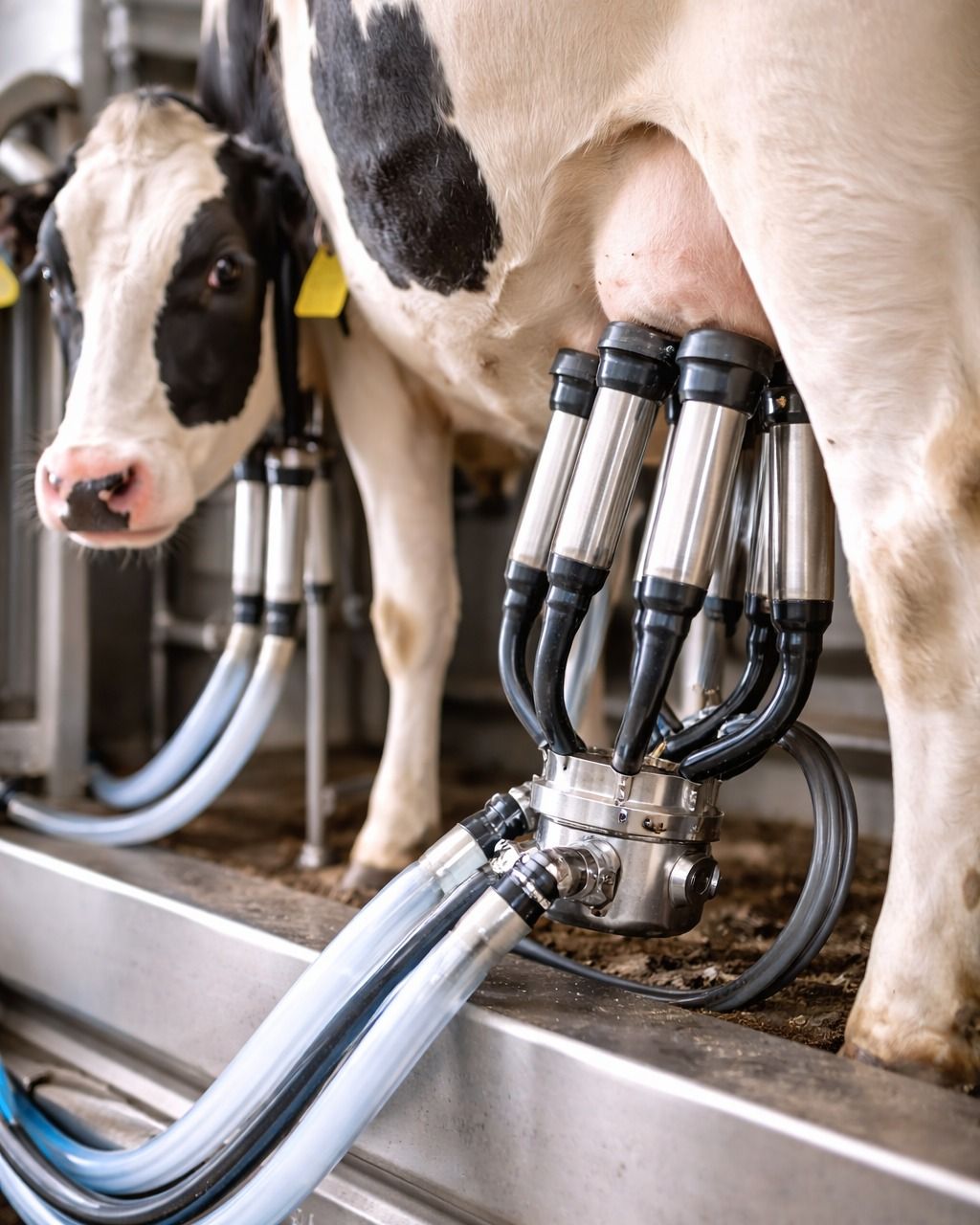
Modern automated milking systems use robotic arms, sensors and computer vision to identify cows and locate the teats before milking. The systems can operate with limited human intervention while collecting information on individual animals.
Depending on the system, farmers can monitor milk production, milking frequency, animal activity and other indicators that may help identify changes in health or behaviour.
Manufacturers including Lely, DeLaval, GEA and Afimilk have developed automated milking technologies for commercial dairy operations.
One of the significant differences between robotic and conventional milking is flexibility. Instead of bringing the entire herd into a parlour according to a fixed schedule, cows can access automated systems according to their individual milking patterns.
This can provide farmers with more detailed information about individual animals while potentially reducing some of the routine labour associated with conventional milking.
The economics remain critical
Despite advances in technology, robotic milking requires substantial capital investment.
The business case depends on factors including herd size, milk production, labour costs, equipment utilisation, electricity supply, maintenance requirements and the availability of technical support.
For African dairy farms, these factors can differ significantly from those in Europe, where labour costs and farm structures have helped drive adoption of automated milking.
The size and structure of a dairy operation are particularly important. Smaller farms may find the capital cost difficult to justify, while larger commercial operations may be able to spread equipment and infrastructure costs across a bigger herd.
This means robotic milking is unlikely to become a universal replacement for conventional parlours. Instead, adoption is more likely to begin with farms where the combination of herd size, labour requirements, production levels and management objectives supports the investment.
Why South Africa is attracting attention
South Africa has one of the continent’s more developed commercial dairy sectors, making it a potential early market for advanced milking technology.
For larger dairy operations, labour availability and rising pressure to improve productivity are among the factors encouraging farmers to examine automation.
However, the economics are not identical to those of European dairy farms. South African producers must consider local labour costs, electricity reliability, technical skills, financing and access to spare parts and maintenance services.
These factors can determine whether automation delivers a sufficient return on investment.
AI adds another layer
The value of robotic milking increasingly extends beyond the milking process itself.
Modern systems generate large amounts of data about individual cows. Information on milk production, activity, feeding behaviour and changes in routine can help farmers identify animals that may require attention.
Artificial intelligence and machine-learning tools are increasingly being incorporated into dairy technology to analyse these data and identify patterns that may be difficult to detect through manual observation alone.
For farmers, this can shift herd management towards a more individualised approach, where decisions are based on the performance and condition of individual animals rather than relying primarily on herd-wide averages.
Early identification of potential health problems could also allow farmers to investigate issues before they develop into more serious production or animal-welfare problems.
Welfare and productivity
Animal welfare is another factor being considered in the adoption of automated milking.
Because cows can interact with robotic milking systems according to their individual routines, automated systems can provide greater flexibility than fixed milking schedules.
The potential benefits, however, depend on farm management and system design. Robotic technology does not automatically guarantee better animal welfare; appropriate cow traffic, nutrition, housing, maintenance and veterinary management remain essential.
The same principle applies to productivity. Automation can provide more data and reduce certain labour requirements, but the financial outcome ultimately depends on how effectively the technology is integrated into the overall farm operation.
A gradual path for African dairy
For African dairy producers, the future of robotic milking is therefore likely to be gradual rather than immediate.
Large, technologically advanced commercial farms are more likely to consider the technology first, while smaller operations may continue to rely on conventional parlours or lower-cost automation.
The availability of technical support will also be important. Robotic milking systems require reliable infrastructure, regular maintenance and staff who can work with the technology and respond when equipment or connectivity problems occur.
As manufacturers continue to improve robotic milking systems, shorten milking times and add more advanced monitoring capabilities, the technology is becoming increasingly mature.
For Africa’s dairy sector, the question is no longer simply whether robotic milking works. The more important question is where and under what conditions it makes commercial sense.
As the continent’s commercial dairy sector develops, robotic milking could become part of a broader shift towards more automated, data-driven and individually managed dairy production.
