


Opening the doors of a commercial piggery to a group of NSPCA inspectors could make any farmer apprehensive. But when inspectors visited Taaibosch Piggery for practical training, the exercise gave both sides an opportunity to test perceptions against what happens inside a commercial farm.
Pig farmers and animal welfare organisations may not always agree on how welfare should be achieved. Yet a day spent inside a commercial piggery demonstrated that those differences do not have to prevent constructive engagement.
Earlier this year, the National Council of SPCAs (NSPCA), the South African Pork Producers’ Organisation (SAPPO) and CS Vet collaborated on a practical welfare training initiative at Taaibosch Piggery in the North West. The objective was to give NSPCA inspectors firsthand exposure to commercial pig production to complement their theoretical training.
The visit became more than a training exercise. It created an opportunity for people who often find themselves on opposing sides of animal welfare debates to better understand each other’s responsibilities, challenges and priorities.
“There is a lot of ‘us’ and ‘them’ in the industry. But the day confirmed that we are all pulling in the same direction, even if we have different ways of getting to the end goal,” says Dr Thandi Chiappero, head of consumer assurance at SAPPO.
For CP Kriek, owner of Taaibosch Piggery, opening the farm to the NSPCA was daunting.
“But we want to be part of the solution by giving inspectors genuine, firsthand experience of a commercial piggery. If they have greater understanding of what production looks like, there will hopefully be less conflict with farmers.
“Farmers and the NSPCA share a concern for pig welfare, but we need to move closer together to allow room for each other to do our jobs and find a midway. Inherently, we will never agree on certain aspects about what constitutes animal welfare, but we need to be able to work together, not against each other.”
Seeing commercial farming firsthand
Misperceptions about pig production can persist among the public and animal welfare groups. Kriek believes one reason is that strict biosecurity measures mean commercial piggeries are generally closed to the public.
“People don’t know what an intensive livestock operation looks like. Most people have seen cattle and have some understanding of how they are farmed, but you don’t see a piggery because the animals are housed indoors.”
People may instead encounter pigs kept in backyards or small-scale production systems, which Kriek says can influence perceptions of commercial pig farming more broadly.
“The reality of a commercial piggery is that it is intensive. But we can make the economics work without mistreating our animals. The public needs to get to a point where they realise that not all intensive farms are factory operations with no heart.”
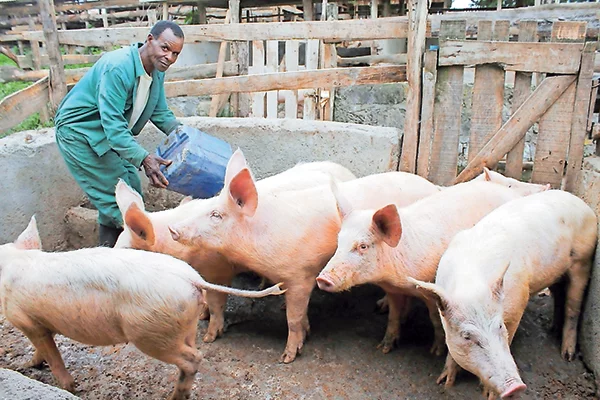
At Taaibosch, inspectors were shown the scale and workings of the operation, including feed use, employment and the farm’s Pork360 welfare standards. Discussions covered reproduction, feeding, euthanasia, the treatment of sick animals and staff training.
Terminology was also important. Kriek explained the differences between insemination, gestation, farrowing and treatment crates, and why each is used.
He was encouraged by the inspectors’ appreciation of the realities of commercial farming.
“They understand that it is a farm that needs to produce meat and generate an income. Many of them grew up on farms, and they are not necessarily against livestock farming or meat consumption. They are against the abuse of animals in farming. That was a crucial point for me. I realised they are not there to fight us. They have a passion and a job to do, just like farmers have.”
Putting welfare into practice
The visit also provided an opportunity to demonstrate how welfare practices at Taaibosch have evolved.
One of the biggest changes has been the move from gestation crates to group housing. This required significant investment and changes to farm management. Sows must adapt to feeding in a group environment, while workers need to manage body condition, grouping and social interactions differently.
The farm has also replaced ear notching with batch traceability and introduced enrichment materials such as chains, hay and sawdust. Sows are provided with material that allows them to express nesting behaviour before farrowing.
Staff training has become another important focus.
“We have moved towards a more respectful way of handling animals, from management through to workers. You don’t shout and slap to get pigs down the passage. You train staff to use a herding board, and the pigs become accustomed to moving that way,” says Kriek.
Preventative health programmes and vaccination have similarly received greater attention, reducing reliance on treatment only after animals become ill.
While some of these changes have involved additional costs, Kriek says production has benefited overall.
“Group housing initially presented a steep learning curve, but sows are more active and fitter, with slightly improved farrowing performance. Moving away from ear notching has also reduced pain and distress in piglets so they perform better.”
Where differences remain
Greater understanding did not erase fundamental differences between commercial producers and animal welfare organisations.
The use of crates remains contentious, particularly in farrowing houses. While welfare concerns focus on restricting sow movement, Kriek says farmers remain concerned about increased piglet mortality if crates are removed.
Tail docking represents another major point of disagreement.
“For a farmer, it is necessary to prevent tail biting and cannibalism, which is necessary to uphold good welfare standards. But for the NSPCA, it is seen as maiming. We don’t agree, and there is not enough research to guide either party. We are at a deadlock. We need more information.”
Chiappero says SAPPO similarly considers the risk of tail biting under current production systems too high to move away from docking at this stage.
“Farrowing crates also remain difficult to phase out while piglets are still at risk of being crushed by sows.”
These debates highlight the broader challenge facing the pork sector: how to improve animal welfare while maintaining economically viable farms and producing affordable pork.
Chiappero cautions against simply importing welfare standards developed for different production environments.
“We can’t compare ourselves to EU standards and assume that is necessarily the way to go. We still need food security and need to produce affordable protein. If you apply too many rules and regulations, it becomes impossible to farm sustainably.”
She says South African welfare standards need to reflect local production realities, including the scale required for farms to operate economically without subsidies.
That does not mean welfare standards will remain static. SAPPO has set 2032 as the deadline for moving away from gestation crates, while its Social Sows initiative promotes greater group housing and social interaction.
Rethinking productivity
Kriek believes the next phase of welfare improvement may also require the industry to reconsider how it measures productivity.
“When super production starts to impede animal welfare, we have a problem. If you keep pushing the number of piglets born alive and eventually reach 30, but half of them don’t make it, it is an issue. We can’t just keep chasing numbers.”
He says the focus is already shifting towards measures such as the number of viable piglets weaned, rather than simply the number born alive.
Technology could increasingly help farmers find a balance between welfare and productivity. Kriek sees opportunities to monitor individual animals more closely so that disease can be detected earlier, while housing design could give pigs greater opportunities to express natural behaviour without compromising production.
Future developments could include farrowing systems that protect piglets while allowing sows greater freedom of movement, group fostering, natural light alongside automated ventilation, and environments that provide opportunities for rest and activity.
“If we erect new buildings, we will incorporate future welfare standards. We can’t simply convert older piggeries into modern facilities, but we can design for the future.”
Collaboration as a way forward
The NSPCA visit highlighted that farmers and animal welfare organisations will not necessarily agree on every aspect of pig welfare. But it also demonstrated the value of direct engagement and practical understanding.
For Kriek, progress depends on accepting that differences will remain while ensuring that those differences do not prevent constructive dialogue.
The industry and the NSPCA may continue to advocate for different approaches, but both have a role to play in improving animal welfare and ensuring that pig farming remains viable.
“You need to be at the table. It comes down to collaboration and understanding. We are not the same, but we must appreciate each other’s differences.”
