



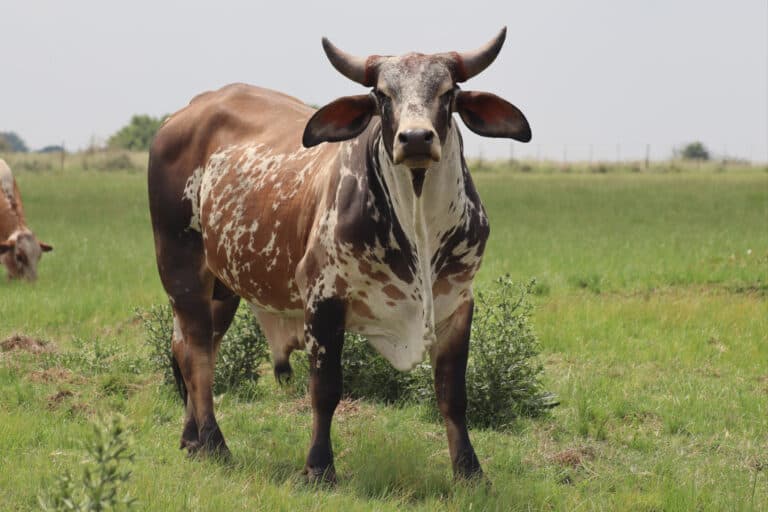
When foot-and-mouth disease (FMD) affected cattle at ZZ2 farms, Nguni animals appeared to experience less impact than several other breeds. The experience strengthened ZZ2’s confidence in the breed’s genetics while prompting further research into the possible biological factors behind the difference.
The outbreak occurred while 68 bulls were participating in a formal Phase D performance test, providing an opportunity to observe how different breeds responded under similar environmental and management conditions.
“The European breeds suffered the most. The least suffering was the Ngunis,” says Potgieter.
Performance Data Revealed Differences
Unlike an outbreak where observations may be largely anecdotal, the Phase D test provided regular performance records. The bulls were weighed every 14 days, allowing changes in growth to be tracked before and after the FMD outbreak.
According to Potgieter, the growth data showed that the Nguni bulls experienced a relatively small and short-lived setback.
“They lost maybe four or five kilograms in about 14 days and then they picked up again,” he says.
The observations increased ZZ2’s interest in understanding whether the Nguni’s response could be linked to genetic or physiological characteristics.
Genomic Research to Investigate FMD Response
The observations have led to a research initiative involving ZZ2 and the University of Pretoria. The project will investigate the possible genetic factors associated with the differences observed between breeds during the outbreak.
The objective is to move beyond field observations and determine whether measurable biological or genomic characteristics could explain the Nguni’s apparent resilience.
“They are going to do genomic-level research to try and determine what the cause of that is,” Potgieter explains.
He stresses that the results must ultimately come from scientific investigation rather than producer observations.
“We believe they will find something saying that inherently the Nguni is less susceptible, but we must allow the science to tell us that,” he says.
Adaptation Remains Central to Selection
The FMD observations have also reinforced ZZ2’s broader focus on environmental adaptation.
The cattle operation in Mooketsi, Limpopo, covers approximately 65 000ha and manages between 4 000 and 6 000 cattle. Animals must cope with heat, tick pressure, rugged terrain and seasonal climatic variation.
For operations manager Asser Mantsho, selecting cattle that are naturally suited to these conditions is essential for maintaining productivity while controlling production costs.
“You must have what is adapted and working for you. Don’t try to change the environment for the cattle. Let the cattle live and adapt in the environment,” Mantsho says.
Fertility Remains a Key Selection Trait
Despite advances in performance recording, digital management and genetic evaluation, fertility remains the most important selection criterion for the herd.
A productive cow must conceive regularly, produce a calf and return to breeding within the required timeframe.
“If an animal can get pregnant annually, wean a calf, and conceive again, it basically means it is adapted to the environment,” Mantsho says.
The operation uses a controlled 65-day breeding season, with a requirement that breeding cows produce a calf every year. The cattle division currently records an average inter-calving period of about 398 days, with average age at first calving at 34 months.
These results are achieved under extensive conditions, with the cattle relying primarily on grazing and protein lick rather than feed-based production systems.
“If you can give us a calf every year from just eating grass and wean a healthy calf, then you’re adapted to the farm,” Mantsho says.
Indigenous Genetics Under the Spotlight
The FMD outbreak has provided an unexpected opportunity to investigate how indigenous cattle genetics may contribute to resilience under disease and environmental pressure.
For ZZ2, the combination of recorded performance data, genomic research and long-term selection for adaptation could provide valuable insights into the role of Nguni genetics in South African beef production.
“The biggest lesson that I learned is that the Nguni is even better than I expected,” says Potgieter.
As climate pressures and temperatures increase, the ability of cattle to maintain fertility and production under challenging conditions could become increasingly important.
