



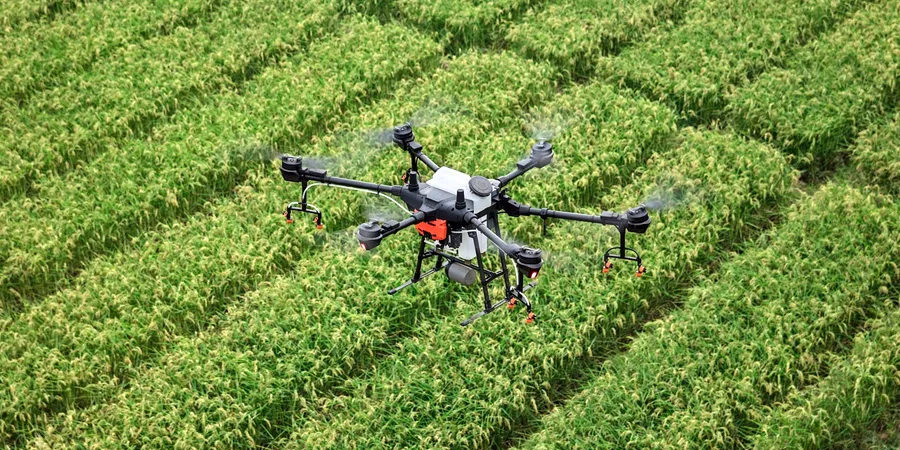
Drones can diagnose crop problems in hours rather than weeks, while AI-powered tools are helping farmers access agricultural advice in local languages. Across Africa, a new generation of agritech solutions is changing how smallholder farmers monitor crops, manage resources and respond to agricultural challenges.
Across Ghana, Nigeria, Kenya and other parts of Africa, agritech entrepreneurs are putting satellite data, artificial intelligence and unmanned aircraft into the hands of farmers. Governments and development institutions are also beginning to support the expansion of these technologies.
For decades, a farmer suspecting disease in a maize or cocoa crop might have had to wait for an agricultural extension officer to inspect the field. In some areas, that process could take days or weeks. AI-powered diagnostics, drones and mobile applications are now helping shorten that gap.
The Flying Farmers
In Ghana, agritech companies are using drones to capture high-resolution images of farmland. AI-powered software can then analyse the imagery for potential signs of crop disease, nutrient deficiencies and water stress. This can help transform field inspections from a largely manual process into a faster, data-driven assessment.
In Nigeria, precision agriculture practitioners are using drones to monitor crops and train farmers in aerial data collection. The broader goal of precision agriculture is to apply water, fertiliser and pesticides where and when they are needed, potentially improving resource efficiency.
Zimbabwe’s eAgro has taken a more accessible approach with CropFix, a mobile tool that allows farmers to photograph a diseased plant and receive an AI-generated assessment of potential pests, diseases or nutrient deficiencies. The system can also work through SMS, helping reach farmers who have limited or unreliable internet access.
Connectivity and digital literacy remain significant challenges in rural communities. Integrating AI-powered agricultural advice into familiar communication channels such as text messaging can make these technologies more accessible.
In Ghana, Farmerline has developed Darli, an AI assistant that allows farmers to seek agricultural information through WhatsApp and in multiple local languages.
Governments Catch Up
What began largely as individual technology initiatives is increasingly becoming part of broader agricultural and digital-development programmes.
In February 2026, the African Development Bank approved $200 million for agricultural programmes in Nigeria covering areas including farm inputs, value chains, climate-smart agriculture and digital data management.
In March 2026, the World Bank announced a $500 million project known as AGROW, focused on improving smallholder productivity and strengthening agribusiness value chains.
Kenya has also incorporated emerging technologies into agricultural education. The Kenya School of Agriculture updated its curriculum in 2025 to include areas such as artificial intelligence, drone operation and big data analysis, reflecting the growing role of digital technologies in agriculture.
Nigeria’s National Information Technology Development Agency has also explored the potential use of drones and AI in supporting national food-security objectives.
Beyond Crop Health
The use of agricultural technology is expanding beyond disease detection and crop monitoring.
In parts of East Africa, drones equipped with night-vision cameras and motion sensors are being used for land and livestock surveillance. These systems can provide farmers with information about activity on farmland that would otherwise be difficult to monitor continuously.
Pastoralists in Kenya are also using satellite data to monitor rainfall and vegetation conditions. Such information can help livestock keepers identify areas with available grazing resources and respond to changing environmental conditions.
A Market Still Finding Its Footing
The growth of agricultural technology is attracting increasing investment and attention. Industry forecasts indicate that the global agricultural drone market could expand substantially over the coming years, while African markets are gradually increasing adoption.
East Africa has also developed a growing ecosystem of agritech companies working across areas including digital farming, financial services, logistics, data analytics and agricultural intelligence.
However, significant challenges remain.
The technology still needs to complement rather than replace agricultural experts, extension officers, cooperatives and farmers’ own experience. AI systems can provide useful information, but their recommendations need to be interpreted within local agricultural and environmental conditions.
Connectivity, digital skills, device affordability and access to reliable data remain important barriers to wider adoption, particularly in rural communities.
There is also a question of inclusion. Ensuring that AI and digital agricultural tools reach women farmers, smallholders and communities with limited access to technology will be critical if the benefits of the digital agriculture transition are to extend beyond larger commercial farms.
Africa’s agricultural technology sector is therefore moving from experimentation toward broader adoption. Drones, AI, satellite imagery and mobile platforms are creating new ways for farmers to collect information, identify problems and make decisions — while the long-term impact will depend on affordability, accessibility, reliable infrastructure and how effectively technology works alongside agricultural knowledge.
