
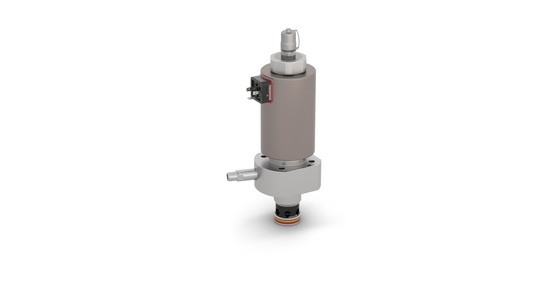
A new direct-controlled seat valve enables storage-free, load-tight holding functions in dynamic linear units without an additional control pressure supply and offers significant advantages over classic, pilot-controlled solutions, particularly in stationary and servo hydraulics.
For many stationary applications in hydraulics, the demands on energy efficiency, process reliability, and maintenance requirements are increasing. The new directly controlled seat valve from WEBER-HYDRAULIK, which can handle large volume flows with minimal pressure drop, creates new scope for action here – both in new development and in system modernization. The valve combines several of these requirements in one powerful design.

Dynamics meets tightness
The focus is on the combination of high flow capacity (e.g., 100 l/min at only 1 bar pressure loss) and almost absolute seat tightness (maximum three drops per minute). This feature is essential, especially in safety-critical holding functions. Unlike conventional slide or proportional valves, the seat design prevents internal leakage – the load remains reliably in position without the need for control pressure.
Switching speed below 200 ms – without control pressure
Switching times of ≤ 70 ms when opening and ≤ 180 ms when closing can be achieved. In many conventional control circuits, a separate control pressure is necessary – either from accumulators or additional pump units. The directly controlled valve, on the other hand, does not require control pressure. This simplifies the design, reduces the number of components, and lowers maintenance costs.
Advantages in mechanical and plant engineering
The valve really comes into its own in machine and plant engineering, where modular, prefabricated plug-and-play units are becoming increasingly important. It can be flowed through on both sides and is therefore suitable for both simple switching functions and reversible motion sequences. In large servo-hydraulic axes – e.g., in presses, test benches, or automation solutions – the combination of dynamics and tightness allows cylinder positions to be reliably maintained even when the pump is switched off.
Another key advantage is the flow-optimized design of the valve, which enables particularly low pressure losses while maintaining high volume flows. This allows servo-hydraulic systems to be designed even more efficiently. The directly controlled seat valve opens up new options for energy-efficient, dynamic, and virtually leak-free hydraulic solutions. For designers who want to dispense with control pressure and at the same time require maximum load reliability, it represents a future-proof alternative to conventional hydraulic valve technology.
“The directly controlled seat valve opens up new options for energy-efficient, dynamic, and virtually leak-free hydraulic solutions. For designers who want to dispense with control pressure while still requiring maximum load reliability, it represents a sustainable alternative to conventional hydraulic valve technology,” explains Dominik Vogt, Head of the Valve Technology Division at the Reichenau site.
