


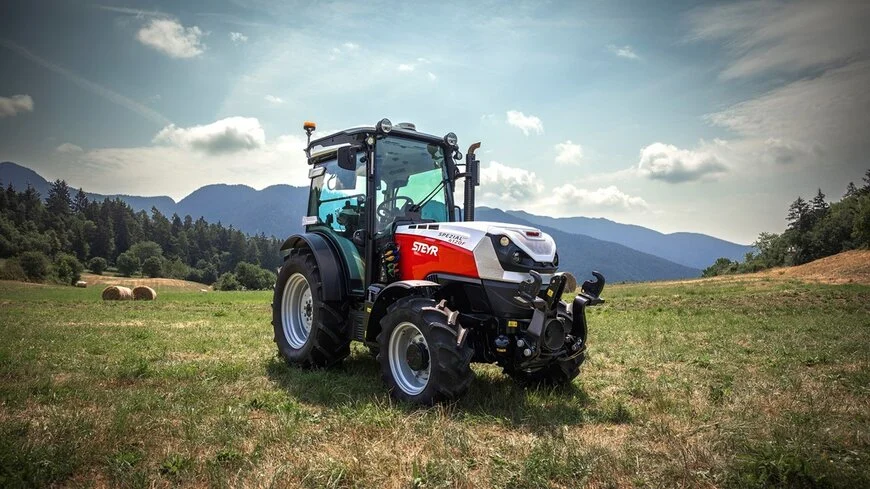
STEYR showcases its 4120 Spezial F CVT, 6440 Cervus CVT and 6200 Impuls CVT at EIMA International 2026, highlighting stepless transmission technology, connected fleet management and improved operational efficiency across specialty and large-scale farming.
Agricultural machinery manufacturer STEYR is showcasing its latest tractor technologies at EIMA International 2026 in Bologna, Italy, with a portfolio designed to address the demands of specialty crop production, heavy-duty fieldwork and connected farm operations.
The lineup includes the 4120 Spezial F CVT for orchards and vineyards, the high-powered 6440 Cervus CVT for demanding arable operations, and the 6200 Impuls CVT for mixed farming, transport and general fieldwork.
At the centre of these developments is continuously variable transmission (CVT) technology, which allows operators to adjust forward speed continuously rather than relying on fixed mechanical gear ratios. Combined with digital connectivity and telematics, these systems aim to improve machine control, productivity and operational efficiency.
CVT Technology for Orchards and Vineyards
Orchards, vineyards and hop yards present unique machinery challenges. Narrow row spacing, restricted turning areas and delicate root zones require compact tractors that can manoeuvre precisely while maintaining sufficient power for sprayers, mulchers and other power take-off (PTO)-driven implements.
The STEYR 4120 Spezial F CVT is designed to address these requirements through a combination of continuously variable transmission technology and a compact chassis.
Unlike conventional stepped transmissions, CVT systems allow operators to adjust ground speed without changing through fixed gears. This can help maintain a suitable travel speed during spraying, mowing and other operations where consistent working conditions are important.
By managing the relationship between engine speed and forward travel, CVT technology can also support efficient power delivery and smoother operation when field conditions change.
The tractor’s compact design and manoeuvrability are particularly relevant in confined orchard and vineyard rows, where precise turning and reduced unnecessary movement can improve workflow efficiency.
For specialty crop producers, the combination of controlled travel speed, implement compatibility and compact dimensions can help simplify repetitive field operations.
High-Power Performance for Demanding Fieldwork
For large-scale arable farming, the STEYR 6440 Cervus CVT addresses the demands of high-draft tillage, heavy seeding and agricultural transport.
With an output of up to 435 hp, the model represents STEYR’s highest-powered production tractor in the lineup described for EIMA 2026.
Its CVT driveline and automated power management are designed to balance engine output and traction requirements across demanding workloads. This is particularly important during operations such as deep ripping and heavy cultivation, where maintaining traction and managing fuel consumption are key operational considerations.
The 6440 Cervus CVT has also received recognition through the BIG SEE International Design Award and a Red Dot Design Award, and was named a finalist in the HighPower category of the Tractor of the Year 2027 awards.
These distinctions add to the model’s profile within the high-powered agricultural machinery segment.
Mid-Range Versatility with the 6200 Impuls CVT
The STEYR 6200 Impuls CVT is designed for mixed and arable farming operations that require a balance between power, versatility and operator comfort.
The model delivers 200 hp of rated power, with maximum output reaching 225 hp. Its intended applications include loading, transport, intermediate tillage and other routine farm tasks.
An updated operator workstation is designed to improve usability and help reduce fatigue during extended working hours.
For farms managing multiple activities throughout the year, this combination of mid-range power, continuously variable transmission and operator-focused design offers flexibility across a range of workloads.
Connected Fleet Management and Precision Agriculture
Beyond mechanical performance, digital connectivity is becoming an increasingly important component of modern agricultural machinery.
Telematics systems allow farm managers to monitor machine location, operating conditions, diagnostics and utilisation, helping them make better-informed decisions about fleet deployment and maintenance.
STEYR’s FieldOps platform brings together machine telematics, diagnostics and relevant operational data through a connected interface. This can help operators and fleet managers monitor machine performance, identify potential maintenance issues and improve coordination across field operations.
The brand’s Connectivity Included approach is designed to provide connectivity on eligible models without recurring telematics subscription charges, helping simplify access to machine data over the ownership period.
Within the wider CNH ecosystem, steering and guidance solutions from Raven and FLEETPRO provide additional options for supported machinery configurations and mixed-fleet operations.
These technologies are relevant to precision agriculture because connected machine data and compatible guidance systems can support more accurate fieldwork, reduce unnecessary overlaps and improve operational planning. Their practical benefits depend on the equipment configuration, software capabilities and the farm’s management practices.
Maintenance, Financing and Total Cost of Ownership
The cost of agricultural machinery extends beyond the initial purchase price. Fuel consumption, servicing, component life, downtime and resale value all contribute to total cost of ownership (TCO).
At EIMA International 2026, CNH Parts and Service highlighted maintenance programmes intended to support equipment reliability and help owners manage servicing requirements throughout the machine’s working life.
CNH Capital also presented financing options for agricultural machinery, including programmes associated with its cooperation within the European Investment Bank’s sustainable financing framework.
Such financing structures may help eligible agricultural businesses access modern equipment, subject to the applicable programme terms and qualification requirements.
For farmers considering an upgrade, evaluating the complete ownership cost alongside machine productivity, operational requirements and financing conditions remains essential.
The Future of Connected Agricultural Machinery
The STEYR lineup illustrates how transmission engineering, machine design and digital connectivity are converging to address different agricultural production challenges.
In specialty crops, compact dimensions and stepless speed control can support precise manoeuvring and consistent implement operation. In large-scale arable farming, high power and automated driveline management address demanding traction requirements. Across both segments, telematics and compatible guidance technologies provide opportunities to improve fleet visibility and operational planning.
As agricultural businesses face increasing pressure to improve productivity and manage operating costs, the integration of mechanical performance and digital tools will remain an important development in modern farm machinery.
From narrow orchard rows to high-power field operations, the objective is to give farmers greater control over machine performance, improve workflow efficiency and make better use of available resources.
